Did you sign up for our weekly newsletter on 'From Lock to Liberation' yet? JOIN US HERE.
JOURNEY WITH KINDRED SOULS
Together, we'll explore the intersection of nervous system science, mental health, spirituality, and healing.
What if there's actually isn't anything wrong?
What if there's actually isn't anything wrong?
Have you ever found yourself replaying a conversation over and over in your mind?
Checking your phone repeatedly because someone hasn't texted back?
Lying awake at night imagining all the things that could go wrong?
Most people assume this is anxiety.
But what if something else is happening?
What if your nervous system is preparing for danger rather than responding to danger?
One of the most common "locks" I see in my work is hypervigilance.
Hypervigilance is not a character flaw. It is not weakness. It is not evidence that you are broken.
It is a protective strategy.
To understand why, it helps to know a little about how the brain works.
Many of us imagine that information comes in through our senses, we assess what's happening, and then we react.
But the brain is actually doing something much more interesting.
Information comes in through our senses—what we see, hear, feel, smell, and taste.
The brain then asks:
"What does this mean?"
To answer that question, it searches through past experiences, emotional learning, relationship experiences, body memories, and previous threats.
Then it creates its best prediction.
That prediction is sent to the nervous system, which begins preparing the body to respond.
Only then do many of the thoughts we're familiar with begin to appear.
The sequence often looks something like this:
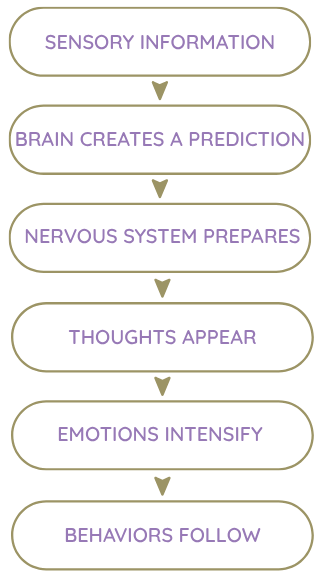
This means that many of the thoughts we struggle with are not necessarily causing our anxiety.
They may be explaining an alarm system that has already been activated.
Imagine your partner usually texts around noon.
It's now 2:00 PM.
The only fact available is:
"No text has arrived."
But if your brain has learned that disconnection, rejection, criticism, abandonment, illness, or disappointment are possible, it may predict danger.
Your nervous system prepares.
Your chest tightens.
Your attention narrows.
And suddenly thoughts begin appearing:
"Did I do something wrong?"
"Are they upset with me?"
"What's going on?"
The mind starts searching for answers to a danger that may not even exist.
This is hypervigilance.
Hypervigilance isn't the nervous system reacting to danger.
It's the nervous system preparing for danger.
And often, the clue that prediction is driving the bus is that the intensity of your response is larger than the information available.
You may be operating from prediction rather than present-moment reality if you notice yourself:
• Preparing for things that haven't happened
• Replaying past events repeatedly
• Rehearsing future conversations
• Scanning for signs of danger
• Seeking certainty
• Feeling compelled to figure everything out before it happens
The good news?
Awareness creates choice.
When we begin recognizing that our nervous system may be responding to what it learned to expect rather than what is happening right now, a little space opens up.
And in that space, healing becomes possible.
This Week's Liberation Question:
What am I preparing for today that may not actually be happening?
60-Second Practice
Take a slow look around the room.
Notice:
• 5 things you can see
• 4 things you can hear
• 3 places your body is being supported
Then gently ask yourself:
"What evidence is available to me right now?"
Not yesterday.
Not tomorrow.
Not the story.
Right now.
Healing doesn't begin when we eliminate every symptom.
It begins when we become curious about the predictions that keep us locked.
Want to receive our weekly newsletter?
SUBSCRIBE TO OUR WEEKLY THURSDAY NEWSLETTER
A weekly newsletter for people who are tired of understanding their patterns and still feeling stuck.