Did you sign up for our weekly newsletter on 'From Lock to Liberation' yet? JOIN US HERE.
JOURNEY WITH KINDRED SOULS
Together, we'll explore the intersection of nervous system science, mental health, spirituality, and healing.
How Yoga Therapy and Brainspotting Help Therapists Heal Trauma at the Body Level
How Yoga Therapy and Brainspotting Help Therapists Heal Trauma at the Body Level
Listen to the conversation
When Understanding Isn't Enough
One of the things I hear most often from clients is some version of this: I know what happened. I've talked about it. I understand it. And yet, I still feel the same.
That gap, between intellectual understanding and felt freedom, is one of the most important puzzles in healing work. And it's exactly what led my podcast guest, Jessica Maitri, to completely reimagine how she practices therapy.
Jessica is a licensed clinical social worker, brainspotting consultant, certified yoga therapist, and the creator of the Yothera Method. In our conversation on The Spiritually Curious Therapist, she walked me through how burnout became a doorway, how two modalities she loves found each other, and why letting go of the therapeutic agenda might be the most powerful thing a healer can do.
By 2015, five years into her private practice, Jessica was exhausted. She was seeing more than 30 clients a week, taking every insurance plan she could, and doing what therapists are taught to do: talk. But something wasn't landing.
She realized her clients were paying her to have a place to talk. And while that has real value, she could feel that it wasn't creating the kind of change she wanted to offer. She needed something different, and she needed it for herself first.
That's When She Started Going to Yoga.
What started as a personal reset eventually became a professional transformation. Jessica trained as a yoga teacher and then pursued a two-year yoga therapy certification through Phoenix Rising Yoga Therapy. She started bringing these principles into her therapy sessions. And she saw something change.
What Yoga Therapy Actually Is (And Isn't)
Here's what I didn't know before this conversation: yoga therapy has almost nothing to do with poses. The word yoga means union. It refers to the integration of body, mind, and spirit, all parts of a person being welcomed into the room.
In a clinical yoga therapy session, there are no instructions to hold warrior pose or breathe a certain way. The therapist creates an attuned, permissive space. The client's body is invited to move however it needs to. Make sound if something wants to come out. Curl up, stretch wide, stay still. Whatever the nervous system is asking for.
The therapist follows. She does not lead.
Jessica calls this edge work. Finding where sensation lives in the body and meeting it there, without pushing, without an agenda for what the body should do next. For anyone with a trauma history, this kind of radical permission is itself a healing experience. Because not having choice is part of how trauma takes hold. Giving it back, gently and consistently, begins to rewrite that.
Brainspotting: Getting Into the Midbrain
Brainspotting works on a deceptively simple premise: where you look affects how you feel. Your eyes are connected, through structures called the superior colliculi, to your brainstem. When you find the specific eye position that activates a trauma memory or emotional pattern, you are literally accessing the file where that experience is stored in the midbrain.
Talk therapy can describe the file. Brainspotting opens it.
When Jessica began integrating yoga therapy with brainspotting, she discovered that adding movement and sensation to an open brainspot dropped clients even more deeply into the material. If a client found a brainspot that activated tightness in their chest, inviting them to gently open that area in their body, to breathe into it or lean into the edge of it, brought even more information forward. The body wasn't just a witness to the memory. It became an active part of processing it.
This is also why these modalities support trauma resolution in ways that insight-based approaches often can't. Trauma isn't stored in the thinking brain. It lives in the body, in the midbrain, in the nervous system. You can't think your way to it. You have to feel your way through it.
In 2020, something unexpected happened to Jessica. She started waking up at 3 am every single day, and instead of trying to fall back asleep, she started writing. Or rather, she started receiving.
For six to eight months, she described waking to what she calls downloads, organized bursts of inspiration that pulled together everything she had been working with. Psychology, shadow work, archetypal theory, yoga therapy. She filled an enormous whiteboard in her office. She organized and reorganized. And then, one day, it was complete.
And she grieved.
She describes it as postpartum, the loss of a creative portal that had held her for nearly a year. The Yothera Method was finished, and now it had to leave the whiteboard and enter the world.
The method moves through three phases. Phase one works with the subconscious, using archetypal exploration and shadow work to identify the old story that has been driving patterns. Phase two brings that story into the body, using yoga therapy principles and all the senses to create a new story through sensation, sound, image, and movement. Phase three grounds that new story into daily life through integration.
What makes it distinct is that it doesn't just create insight. It creates a new embodied experience. One the nervous system can actually work with.
The Hardest Skill: Letting Go of the Agenda
One of the most honest things Jessica said in our conversation is that healing happens when we stop pushing for it.
That is not what most of us were trained to do. We were trained to set goals, track progress, document outcomes. We were taught that our clients' healing reflects on us. And that kind of pressure, the sense that we are responsible for the result, is part of what burns therapists out.
But the deeper you go into somatic and energy-based work, the more you bump into this truth: the healer's job is not to fix. It's to create the conditions where fixing can happen naturally. To be regulated and present and out of the way.
Presence, not intervention, is the foundation.
Pain Reprocessing Therapy: Relating to Pain Differently
Pain reprocessing therapy, or PRT, is an evidence-based approach to chronic pain that uses a tool called somatic tracking as its primary method. The goal is to help the brain reprocess pain through a lens of safety rather than fear.
This does not mean convincing yourself that the pain isn't there. It means learning to be with the sensation differently. To approach it with curiosity instead of dread. To notice it without immediately catastrophizing. To stay outcome-independent, which means you practice the tools not to get rid of the pain, but to change your relationship with it.
I know that sounds like it could feel like gaslighting. Georgia and I talked about that directly. Because it can feel that way, especially for people who have spent years being dismissed by doctors and told it was all in their heads. That history is real and it matters.
What makes PRT different is that it doesn't ask you to pretend the pain isn't real. It acknowledges that the pain is real, and it helps your nervous system update its understanding of what that sensation means. Not a threat. Not evidence that something is broken. Just information from a brain that's been working overtime for too long.
What This Means for the Nervous System
From my own perspective, working with nervous system regulation every day, what Jessica is describing makes complete sense. When we offer choice, when we follow instead of lead, when we invite the body without demanding it, we are creating safety at a physiological level.
And safety is always the prerequisite.
The nervous system cannot process, integrate, or heal when it is braced for what comes next. It can only let go when it trusts that letting go won't be dangerous. Everything Jessica described, the radical permission of yoga therapy, the client-centered attunement of brainspotting, the embodied integration of the Yothera Method, is fundamentally about creating that safety.
And once safety is there, the body knows what to do.
Where to Find Jessica
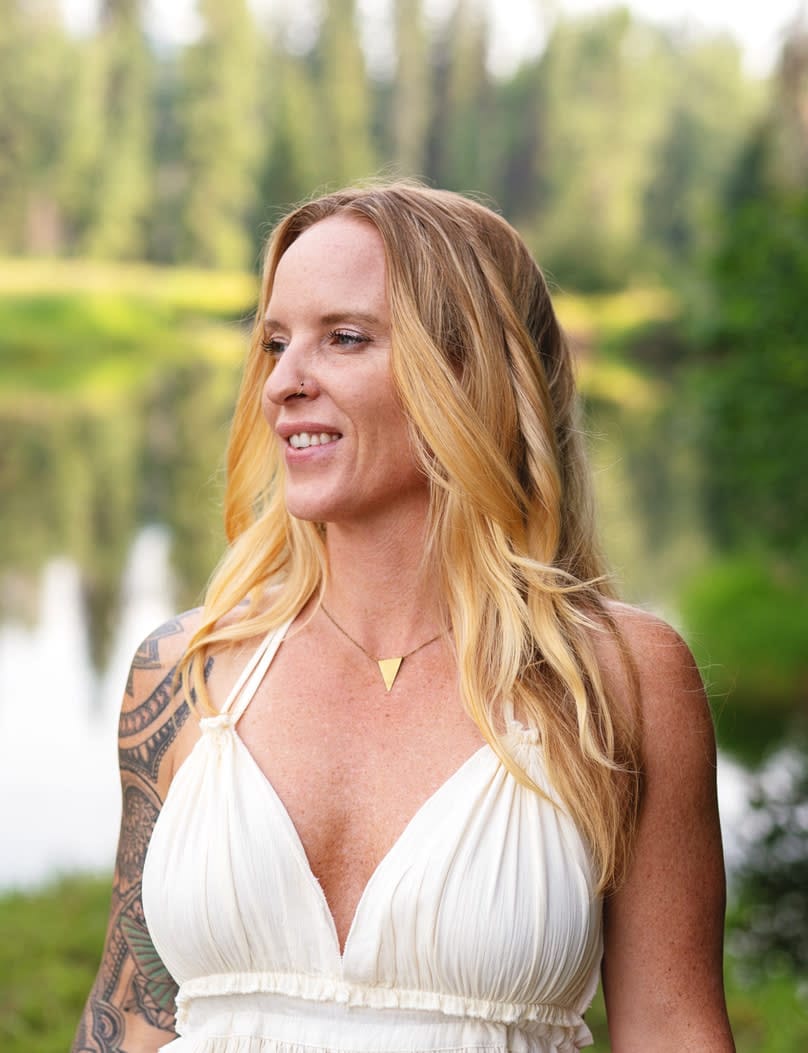
She is a licensed clinical social worker, brainspotting consultant, certified yoga therapist, breathwork practitioner, and intuitive energy healer. She is also the creator of the Yothera Method, a therapeutic modality that blends somatics, yoga therapy, and brainspotting to help people move through the stories their bodies are holding.
If this conversation is calling to you, you can listen to the full episode of The Spiritually Curious Therapist wherever you get your podcasts.
SUBSCRIBE TO OUR WEEKLY THURSDAY NEWSLETTER
A weekly newsletter for people who are tired of understanding their patterns and still feeling stuck.