Did you sign up for our weekly newsletter on 'From Lock to Liberation' yet? JOIN US HERE.
JOURNEY WITH KINDRED SOULS
Together, we'll explore the intersection of nervous system science, mental health, spirituality, and healing.
Why Your Body Freezes Under Pressure (And What to Do About It)
Why Your Body Freezes Under Pressure (And What to Do About It)
Listen to the conversation
Some conversations stay with you for a long time after the recording stops. My conversation with Nahum Vizakis was one of those. Nahum is a lot of things. A former US Army EOD operator, a competitive bodybuilder, a fascial stretch therapist, an astrologer, an entheogenic healer, and the author of two books. But the thing that struck me most about talking to him wasn't his resume. It was how honest he was about every single thing that broke him, and how clearly he could trace the thread between that breaking and who he became.
This is what happened when I sat down with Nahum for The Spiritually Curious Therapist.
A Childhood That Required Survival, Not Thriving
Nahum doesn't sugarcoat his early years. He grew up in a home with constant conflict, started running away at age 10, and eventually found himself bouncing through 17 different foster homes over the course of three years. He got emancipated at 17 and a half. Joined a gang. Attempted suicide. And eventually ended up homeless, sleeping on a park bench in the winter at 19 years old.
He called his mom. She said yes. He moved home for three months, got his GED, got a job, bought a car, and then got the message that it was time to move on.
What strikes me about that part of his story isn't the hardship, though there was plenty of it. It's the absence of the foundational things we know children need to regulate and attach and feel safe. There was no consistent secure figure. No one teaching him how to be with himself. He went into the world before he had the resources to meet it.
That's not a character flaw. That's a nervous system doing what it had to do with what it was given.
The Moment a Soldier Froze
Nahum joined the military and eventually made it into EOD, explosive ordnance disposal. He was trained to walk up to bombs and render them safe. By his own account, he was excellent in training. Confident. Skilled.
Then he got to Iraq. His first real mission. He pulled out what he thought was bomb-making material. It was a fully assembled IED. And when the reality of that hit him, something his training never prepared him for, he froze.
He expected himself to act. Instead, his body stopped.
I've talked about the freeze response a lot in my work, but hearing it described from the inside, from someone who had every reason to believe he wouldn't freeze, was something else. Nahum says that moment planted a seed of doubt that he spent years confronting. He didn't understand yet that what his body did had nothing to do with weakness. His nervous system perceived a life-or-death threat and did what nervous systems do. It tried to survive.
That's not failure. That's biology.
What Nahum chose to do with that experience is what set him on a different path.
Sixteen Medications and a Shell of Himself
After leaving the military with a PTSD diagnosis and a sensitive brain that had been rocked by multiple explosions, Nahum was put through the conventional treatment system. Talk therapy. Medications. At one point, he was on 16 different pharmaceuticals at the same time.
He describes feeling numb. Like a shell of himself. Getting handed diagnosis after diagnosis while watching the people around him deteriorate or die.
So he stopped. He weaned off the medications on his own, started training, started moving, and slowly started to feel like himself again.
I want to be clear here: I'm not suggesting anyone stop medications without medical guidance. What I am noticing in Nahum's story, and in so many of the stories I hear, is that the conventional model often tries to manage symptoms without touching the nervous system underneath them. Nahum's body wasn't broken.
It was responding to a lifetime of threat without ever being taught how to come back down.
Movement gave him a way back. But that was just the beginning.
The Somato-Emotional Release That Changed Everything
Nahum enrolled in massage school and found himself doing something he had never done before. Slowing down. Getting present. Learning to activate his parasympathetic nervous system.
After about two months of daily practice, he started getting severe pain behind his right eye. One day it became unbearable. A classmate asked if he could work on him. Nahum said yes.
What followed was two hours of what his instructor called the most intense somato-emotional release he had ever seen. Nahum's body shook, cried, made sounds he couldn't control. Decades of sympathetic dominance locked inside layers of muscle and fascia finally had a window to release.
A somato-emotional release is a real phenomenon in bodywork and somatic therapy. It's what happens when the body finally feels safe enough to let go of what it has been holding. For Nahum, who had been building muscle and armor simultaneously for years, that release was seismic.
He says his vibration shifted completely afterward. He stopped lifting for three years. Changed his relationships. Changed what he ate. The whole trajectory of his life altered because his body finally had the chance to exhale.
This is what we mean when we talk about healing at the nervous system level. It doesn't look like a lightbulb moment in a therapist's office. Sometimes it looks like flopping around on a massage table in front of 27 classmates.
Fear as a Compass, Not a Stop Sign
One of the things I kept coming back to in our conversation was the way Nahum talks about fear now versus how he related to it earlier in his life.
He says he used fear as a compass. Not something to avoid or suppress, but a signal pointing toward exactly where the work is.
He talks about biohacking through this lens, voluntarily putting yourself in uncomfortable situations so that when life inevitably delivers something hard, you have a baseline. Cold plunges. Demanding physical challenges. Facing the thing that makes you want to run.
I think there's an important nuance here that I want to name. This is not the same as forcing someone into discomfort before their nervous system is ready. That's not healing, that's re-traumatization. What Nahum describes is a gradual, intentional, self-directed practice of expanding tolerance over time. There's a big difference.
For those of us working with people who have experienced significant trauma, that distinction matters enormously.
The Session with His Father
Toward the end of our conversation, Nahum told a story that I haven't been able to stop thinking about.
He went home to Massachusetts in 2022 during a difficult period in his own life. While he was there, he offered to do a bodywork session on his father, a retired police officer who had never allowed himself to be touched, who had worked 100-hour weeks for most of his adult life, and who carried decades of unspoken regret in his body.
Three hours in, Nahum did a specific hip stretch. Something released in his father's spine. Audibly.
His father, a man Nahum had never seen cry in his entire life, looked up at the ceiling and wept.
Nahum describes a weight lifting off his own soul in that moment. Years of history between them. Conflict and distance and pain on both sides. And then one session, one moment of the body finally letting go, cracked something open that talking never had.
His father's habits changed after that. He slowed down. He started being present with Nahum's mother. He stopped using work to hide.
Nahum calls himself the generational curse breaker. I call it what happens when someone does enough of their own healing to hold space for someone else's, even someone who once caused them harm.
That is the work.
Karma, Dharma, and the Nervous System
Nahum also introduced something that I found genuinely thought-provoking. He talks about a collective shift happening right now from karma to dharma. From paying off lessons to actually living your purpose.
He connects this directly to nervous system work. The idea that as we grow and expand, the old stuff surfaces. And if we don't have the regulation to sit with the discomfort, we'll reach for distraction, numbing, isolation, or escapism. We'll miss the threshold.
Biohacking, in his framework, is about building the capacity to stay present with that threshold instead of running from it.
I think about this in the context of what I do every day. The work of creating enough nervous system safety that the old patterns can surface and shift. It's the same underlying principle, just a different language.
What I'm Taking From This Conversation
Nahum is not a therapist. He's not coming from the same training or framework that I am. But I found so much resonance in what he shared, and I think that's worth paying attention to.
We're both talking about the body as a site of intelligence, not malfunction. We're both saying that insight alone doesn't move the stuck things. We're both pointing to the need for safety and regulation as a precondition for real change.
The paths look different. The language is different. But the destination feels like the same one.
Where to Find Nahum
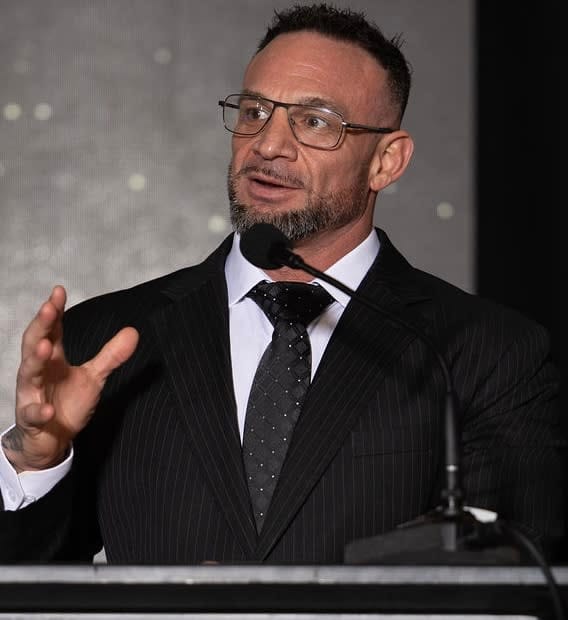
A former US Army EOD operator, a competitive bodybuilder, a fascial stretch therapist, an astrologer, an entheogenic healer, and the author of two books.
Connect with him:
• IG: Spiritual_Bodybuilder
• Youtube: Spiritual Bodybuilder
• Tiktok: Spiritual Bodybuilder
• Website: www.optimizinghuman.com
If this conversation sparked something in you, the full episode is waiting on The Spiritually Curious Therapist wherever you get your podcasts. Nahum and I also agreed to do a follow-up, so if you have questions you want me to bring back to him, send them my way.
SUBSCRIBE TO OUR WEEKLY THURSDAY NEWSLETTER
A weekly newsletter for people who are tired of understanding their patterns and still feeling stuck.